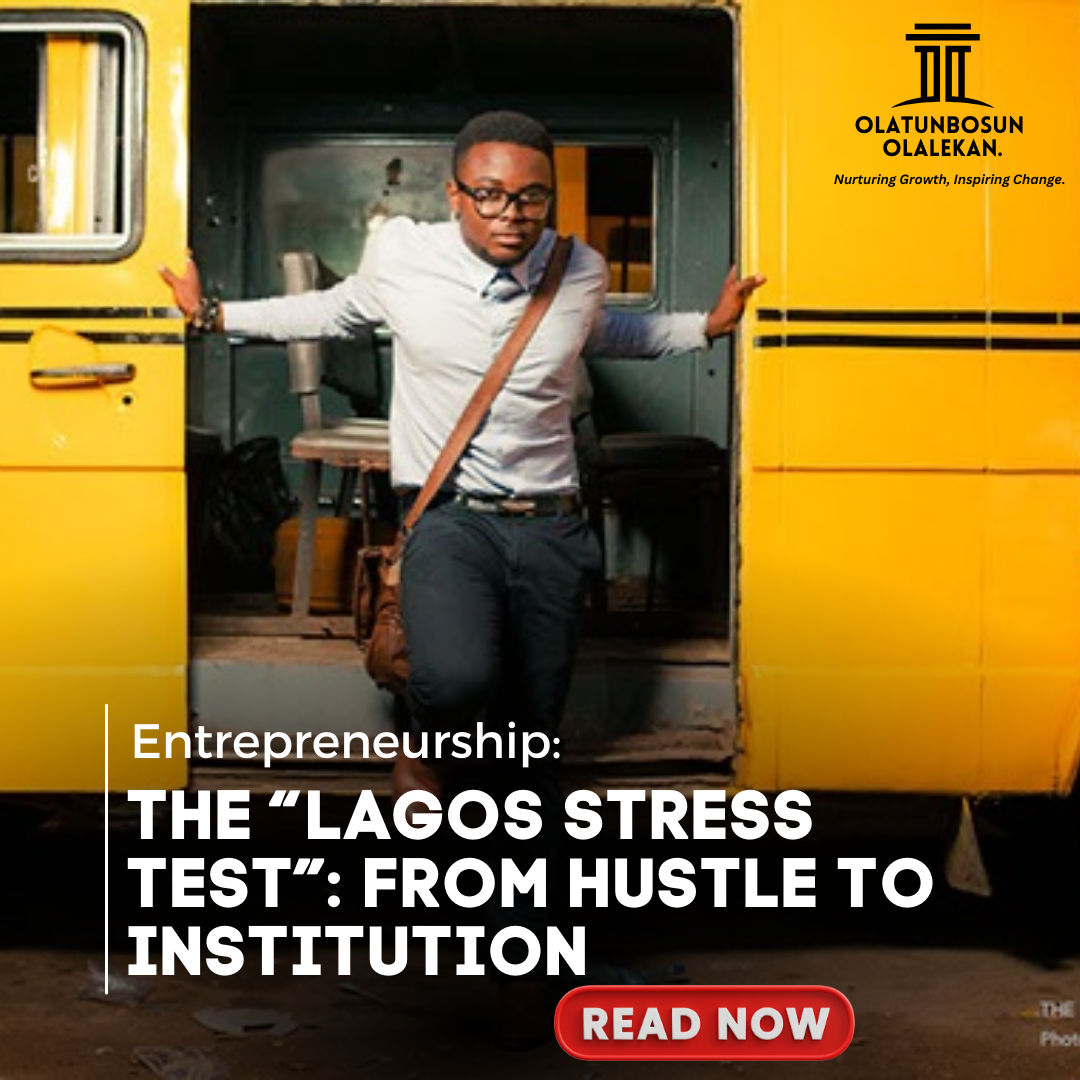

In global business schools, we are taught that strategy is a linear path: you set a five-year vision, align your KPIs, and execute. But as any business owner operating in Lagos knows, a five-year plan often doesn’t survive a five-minute conversation with a supplier. In our environment, the challenge isn’t just market competition; it is operational friction. This is what I call the “Lagos Stress Test.” It is not merely about navigating inflation; it is about managing the daily chaos of logistics, power, and talent retention while trying to build a world-class structure. For the SME founder, the test is simple: can your business function effectively when the generator fails, the prices change while goods are in transit, and your key manager resigns to “Japa” all in the same week?
Too many Nigerian SMEs rely on the sheer grit of the founder to survive this test. We call it “hustle,” and we wear it like a badge of honor. However, as a management consultant, I argue that hustle is not a strategy; it is a phase. The true “Lagos Stress Test” is not how hard the founder can work, but how well the systems can work without the founder. The difference between a small business that stays small and one that scales globally is the transition from “personality-led” operations to “process-led” strategy. It is about moving from “I trust my brother to handle the cash” to “I trust the financial controls we have implemented.”
This is where the local reality meets global best practice. In stable markets, efficiency is the goal. In our market, agility is the prize. But agility does not mean chaos. True agility requires a rigid backbone of structure, clear job descriptions, documented standard operating procedures (SOPs), and data-driven decision-making rather than gut feeling. When I advise MSMEs, I see that those who pass the stress test are the ones who treat their data with the same respect as their inventory. They don’t just check the bank balance; they track unit economics and customer retention rates, using facts to navigate the uncertainty rather than relying on prayer and adrenaline alone.
My message to the Nigerian entrepreneur is to stop apologizing for the volatility of our market and start leveraging it. If you can build a customer service team that maintains global standards despite local frustrations, or a supply chain that delivers on time despite Lagos traffic, you haven’t just built a local business; you have forged an antifragile organization. The “Lagos Stress Test” proves that if you can structure a business here, replacing the chaos of the street with the clarity of strategy, you are not just surviving. You are building a legacy that is ready for the world.
Keep keeping on!